
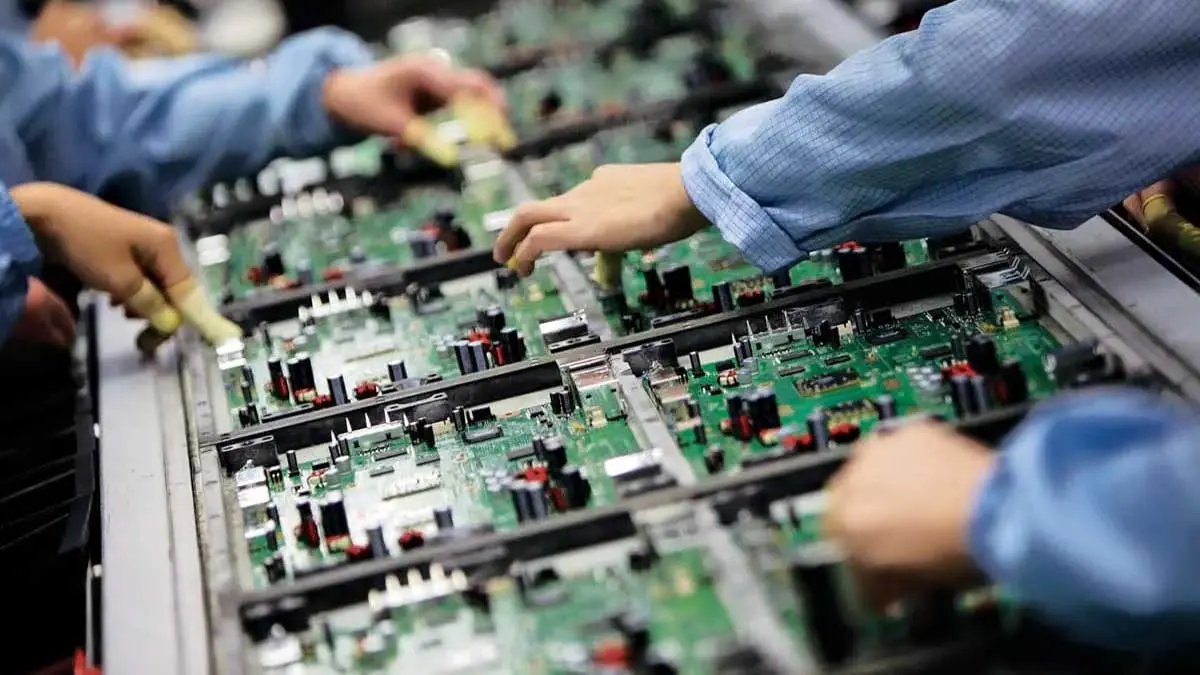
How to Prevent Component Damage During PCB Depaneling: The Case for Laser Cutting
If you are running a high-volume SMT line and constantly battling component damage, micro-cracks, or mysterious field failures after board separation, we will give you the direct answer right now: stop using physical cutting tools on high-density boards.
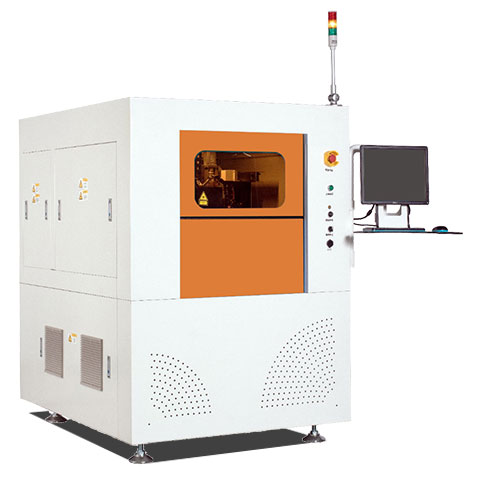
By upgrading to a PCB laser cutting machine, you remove mechanical stress from the equation entirely. The immediate benefits are undeniable: you can drop your scrap rate from a painful 5–10% down to under 1%, entirely eliminate MLCC (Multi-Layer Ceramic Capacitor) flex cracking, and ultimately achieve the lowest total cost of ownership.
In our years of optimizing EMS (Electronic Manufacturing Services) production lines, we have seen process engineers waste weeks tweaking router bit speeds and V-cut depths, only to realize their modern, tightly-packed PCBAs simply cannot handle physical vibration. Let’s cut the fluff and look at the actual engineering data, why your components are failing, and how a non-contact solution fixes it permanently.
Jadual Kandungan
The Hidden Cost of Depaneling Stress: Why Components Fail
We often see perfectly assembled boards pass AOI (Automated Optical Inspection) and ICT (In-Circuit Testing) on the factory floor, only to fail in the field. Why? Because the final step—depaneling—introduced invisible mechanical stress.
The MLCC Micro-Crack Epidemic
Ceramic capacitors are incredibly brittle. When a board is bent during manual V-cut snapping or vibrated aggressively by a dull router bit, the FR-4 substrate flexes. The ceramic body of the MLCC cannot flex, so it cracks.
“A NASA report notes that flex cracks are responsible for up to 80% of low-voltage MLCC failures in space electronics.”— Source: meetceras
These fractures usually start at the terminations and propagate inward. What’s worse, moisture can enter these micro-cracks over time, causing Conductive Anodic Filament (CAF) growth. This leads to a dead short weeks or months after the product has been shipped to the customer.
BGA Pad Cratering
For high-density interconnect (HDI) boards, BGA packages often sit precariously close to the board edge. When a mechanical router mills the edge, the chatter and vibration travel through the laminate. Instead of the solder ball breaking, the actual fiberglass laminate underneath the pad craters and tears away.
According to industry studies, relying on improper or outdated separation methods causes serious yield drops:
“Improper depaneling can lead to failure rates as high as 5-10% in sensitive applications.”— Source: allpcb
Why a Laser Machine is the Ultimate Fix
When we consult for automotive and Apple-tier OEM manufacturers, the transition to zero stress cutting is non-negotiable. Here is exactly why a laser machine outperforms traditional methods.
1. True Non-Contact Separation
A mechanical router relies on physical friction. A laser uses a focused beam of UV or CO2 light to vaporize the FR-4 or polyimide material layer by layer. There is absolutely no physical contact with the board.
To put this in perspective, capacitor manufacturers like Murata recommend keeping mechanical strain below 500 µstrain to prevent damage.
“Mechanical routers often spike above 800-1000 µstrain as bits dull. Laser depaneling consistently keeps stress below 50 µstrain.”
2. Reclaiming Board Real Estate (0.5mm Clearance)
With standard mechanical routing, you must leave a massive “keep-out” zone near the board edge to prevent component damage from vibration. With laser depaneling precision, you can pack components incredibly tight.
“Keep MLCC capacitors at least 2mm from routed edges… For laser depaneling, MLCC can be placed as close as 0.5mm from the edge.”
This 1.5mm difference per edge allows layout designers to shrink the overall PCBA size, drastically reducing FR-4 material costs across millions of units.
3. No Consumables, No Production Drift
Router bits wear out. The 100th board cut with a router bit will experience more stress and have a rougher edge than the 1st board. Lasers do not dull. The beam delivers the exact same energy profile 24/7, ensuring absolute consistency without the need to halt the machine for tool changes.
Best Practices for Implementing Laser Depaneling
Having the right machine is only half the battle. How you integrate it dictates your success. Here are the engineering best practices we enforce when deploying automated pcb depaneling solutions.
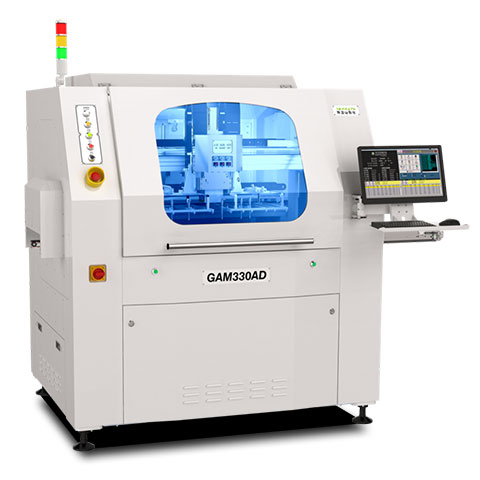
- Practice 1: Optimize Panel Design for Vision Systems.
Always include at least two global fiducials on the panel frame and local fiducials near complex cuts. High-end laser systems use CCD cameras to compensate for PCB shrinkage or stretch in real-time, ensuring the cut is always dead-center. - Practice 2: Clear the Path for Fumes.
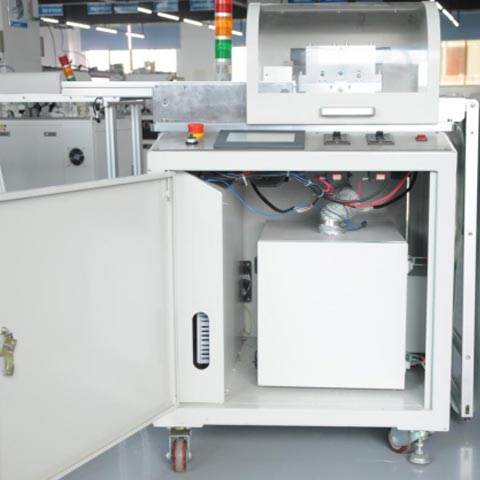
Unlike an advanced pcb router machine which creates heavy FR-4 dust that requires vacuuming, lasers create vaporized fumes. Ensure your panel design allows clearance for localized fume extraction nozzles to keep the optical lens clean and the cleanroom environment pristine. - Practice 3: Automate the Handling.
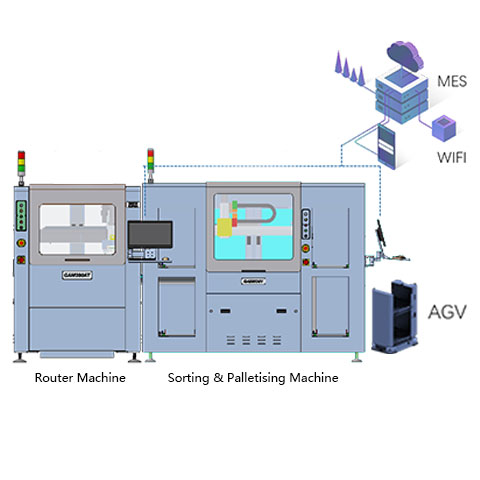
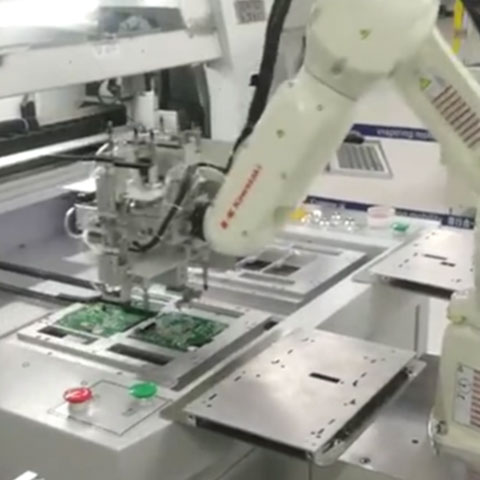
To truly eliminate human error, integrate the laser into an inline depaneling system. Feeding panels directly from the SMT conveyor into the laser machine, and using a robotic arm to place the singulated boards into custom trays, removes the operator from the equation entirely.
Data-Driven ROI: Is the Investment Worth It?
Factory owners often hesitate at the upfront cost of laser equipment. However, when you calculate the Total Cost of Ownership (TCO) based on scrap reduction, the machine pays for itself astonishingly fast.
Depaneling Methods Comparison Data
| Feature | Manual V-Cut Snapping | Mechanical Routing | PCB Laser Cutting Machine |
| Component Stress | Extremely High (>800 µstrain) | Moderate (Vibration based) | Zero (<50 µstrain) |
| Component Clearance | 3.0 mm | 1.5 – 2.0 mm | 0.5 mm |
| Edge Quality | Rough, glass fibers exposed | Good, but tool wear causes burrs | Perfect, clean ablation |
| Consumable Cost | Low | High (Router bits, custom jigs) | Zero (No bits needed) |
If you are currently relying on manual separation, you are bleeding money through hidden rework and scrap.
“Manual Depaneling: Scrap rates of 5%-15%… Automated Depaneling: Scrap rates of 0.5%-2%… laser machines (1%-2% for delicate FPCs/micro-PCBs).”
If your facility produces 2,000 high-value automotive panels a month, reducing a 5% scrap/rework rate down to 1% translates to tens of thousands of dollars saved monthly. You aren’t just buying a machine; you are buying an insurance policy for your yield rate.
Frequently Asked Questions (FAQ)
Q1. What is the safest way to separate high-density PCBs?
The safest method is non-contact laser depaneling. By using a UV or CO2 laser to vaporize the tab material, you eliminate the mechanical friction and vibration that causes micro-cracks in sensitive components like MLCCs and BGAs.
Q2. Can a laser cutting machine handle Rigid-Flex boards?
Yes, this is one of the biggest advantages of laser technology. Mechanical routers struggle with the transition between rigid FR-4 and flexible polyimide. Lasers can change cutting parameters on the fly, seamlessly cutting through both materials in a single pass without tearing the flex circuit.
Q3. How much clearance do I need for components during laser depaneling?
Because lasers exert zero mechanical stress, you can safely place components as close as 0.5mm from the cutting edge. This is a massive improvement over the 2.0mm to 3.0mm clearance required for traditional routing or V-cut snapping.
Q4. Why do my ceramic capacitors pass factory testing but fail in the field?
Mechanical stress during traditional depaneling creates microscopic hairline fractures inside the MLCC body. These micro-cracks rarely trigger an immediate short circuit during in-factory ICT testing. However, under field vibration or thermal expansion, the crack widens, allows moisture in, and eventually causes a catastrophic electrical short.
Q5. Is laser depaneling slower than mechanical routing?
For thick boards (over 1.6mm) requiring full straight cuts, lasers can be slower than V-cut machines. However, for complex shapes, thin substrates, FPCs, or high-density boards where router speed must be severely restricted to prevent vibration, lasers offer highly competitive cycle times with infinitely better yield rates.