
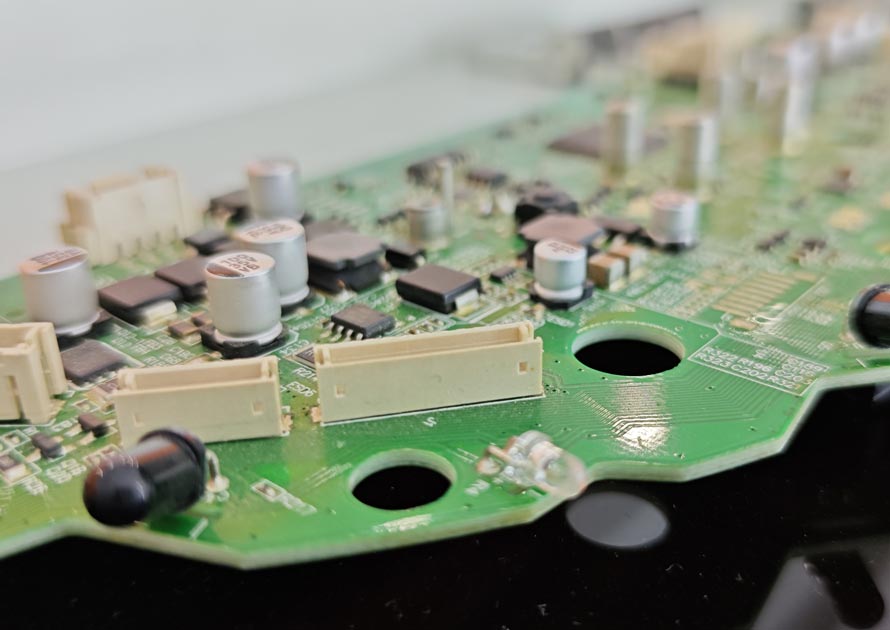
How EMS Factories Balance Cost and Quality with V-Cut PCB Depaneling Machine
If you are a Manufacturing Engineer or an SMT Production Manager, you are likely fighting a daily battle: how do you push high-volume production out the door without compromising the structural integrity of your printed circuit boards? We know exactly what you are going through. You invest millions of dollars into state-of-the-art pick-and-place machines and precision reflow ovens, only to risk destroying sensitive 0201 packages and ceramic capacitors during the very last step—board separation.
Here is the direct answer to your problem: Stop relying on manual snapping and outdated tools. The most effective way to balance your Total Cost of Ownership (TCO) with zero-defect quality is by matching the specific design of your panelized board with automated v-cut pcb depaneling machine for high-volume rigid boards, and upgrading to a pcb laser cutting machine for sensitive, high-density, or flexible applications.
By strategically selecting the right depaneling equipment, we can help you eliminate mechanical stress, drastically cut down your scrap rates, and integrate the final step of your assembly directly into your inline Smart Factory setup. In this comprehensive guide, we are sharing our decades of engineering experience to show you exactly why you should upgrade, the tangible ROI benefits, and how to choose the right technology for your EMS factory.
Mục lục
1. The Hidden Costs of Scrap and The Exploding Depaneling Market
For a long time, the industry treated PCB depaneling as an afterthought. Operators would simply break V-scored panels by hand over the edge of a workbench. However, as modern Surface Mount Technology (SMT) evolves, component packages are shrinking, and board substrates like FR4 and Flexible Printed Circuits (FPC) are becoming thinner.
When you manually break a board, you introduce sheer mechanical stress and torque. This flexing creates micro-cracks in brittle components like MLCCs (Multilayer Ceramic Capacitors). The terrifying part? These micro-cracks often pass end-of-line electrical testing, only to fail months later when the product is in the hands of the end-user. The cost of a field failure, warranty claims, and brand damage far exceeds the price of proper equipment.
The electronics manufacturing industry has woken up to this reality. According to a comprehensive market report by Dataintelo, the global PCB Depaneling Equipment market reached
Why are factory owners pouring money into this? Because modern machines guarantee process stability. Whether it is an automotive electronics OEM requiring absolute zero stress, or an IoT device maker needing high-speed throughput, automating the separation process is no longer optional—it is a strict requirement for survival.
2. V-Cut PCB Depaneling: The King of High-Volume Cost Efficiency
When we audit SMT lines for high-volume consumer electronics, we often recommend sticking to the V-scoring method. If your panel consists of straight-line, rectangular boards (like LED lighting strips, power supplies, or basic motherboards), this method is an absolute powerhouse for your budget.
Why Choose It?
V-scoring is done during the bare board fabrication phase, where a shallow V-shaped groove is milled into the top and bottom of the panel. During final assembly, you only need to separate the remaining thin web of material.
The financial benefits are massive. Data shows that for a production run of 10,000 units, utilizing V-scoring can save up to 20% to 30% in depaneling costs compared to traditional CNC routing. You use less machine time, consume fewer expensive drill bits, and drastically reduce the cycle time per panel.
How to Solve the Mechanical Stress Problem
While V-scoring is cheap, manual snapping is dangerous. To get the benefits of V-scoring without the risk of micro-cracks, you must automate the process. We highly advise deploying an automated v-groove saw depaneling system.
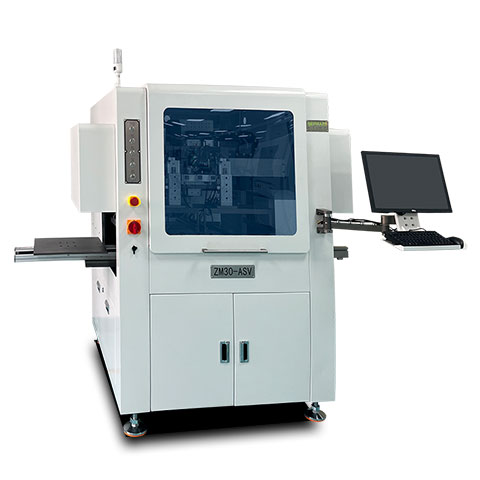
These machines use motorized, ultra-precise circular blades made of high-speed steel. As the panel is fed into the machine, the rotary blades glide seamlessly through the pre-scored groove. Because the blades do the work, there is virtually zero bending or twisting applied to the board.
The Engineering Benefit:
- Throughput: Easily handles thousands of panels per shift.
- Component Clearance: High-quality circular blades can pass safely even when components are placed within 1mm to 2mm of the score line.
- Tooling Cost: Blades last significantly longer than router bits.
3. The Ultimate Upgrade: PCB Laser Cutting Machine
What if your customer is an Apple supply chain OEM, an automotive electronics manufacturer, or a medical device company? In these sectors, the tolerance for mechanical stress is exactly zero. Furthermore, these designs often use complex High-Density Interconnect (HDI) boards, Rigid-Flex combinations, and ultra-thin substrates. V-scoring simply cannot handle curves or flexible materials.
This is where a laser depaneling machine shifts from being a “luxury” to an absolute necessity.
Zero Mechanical Stress and Superior Edge Quality
Laser systems (typically utilizing 355nm UV DPSS lasers or green lasers) use a cold ablation process. The laser beam vaporizes the FR4 or Polyimide material without making physical contact with the board. No contact means no friction, no vibration, and absolutely zero mechanical stress. You completely eliminate the risk of burrs, splinters, and component damage.
The Ultimate ROI: Material Savings via Kerf Width
Many factory owners hesitate at the initial capital expenditure (CapEx) of laser equipment. However, as experts, we always point them to the hidden ROI: Substrate Material Savings.
A traditional mechanical router bit requires a cutting channel (kerf width) of anywhere from 1000 µm to 3000 µm (1mm – 3mm). A focused laser beam requires a cutting channel of less than 20 µm to 50 µm.
Because the laser beam is microscopic, you can pack your individual circuits significantly closer together on the fabrication array. Depending on your board size, upgrading to a laser system can yield up to 30% material savings per panel. When you are processing expensive ceramic substrates or multi-layer rigid-flex boards, that 30% saving pays off the laser machine faster than you might think.
4. Finding the Middle Ground: Routers and Punching Dies
Not every EMS factory needs a laser, and not every board can be V-scored. For high-mix, medium-volume manufacturing environments, we rely on CNC mechanical solutions.
When to Use a PCB Router Machine
If your PCB has irregular shapes, internal cutouts, or “mouse bites” (tab routing), a pcb router machine is the industry standard. These machines use a high-speed rotating spindle (often exceeding 60,000 RPM) to mill through the FR4 tabs.
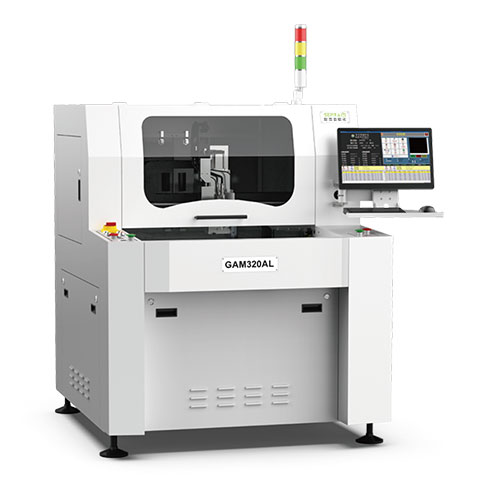
- Pros: Incredible flexibility. By simply uploading a new custom programming path, you can switch from cutting circular IoT boards to complex L-shaped motor controllers. Modern routers offer axis repeatability of ±0.02mm.
- Cons: They generate dust. You must ensure the equipment has a high-grade vacuum dust extraction system to maintain “technical cleanliness” and protect exposed solder pads.
When to Use a Punching Machine
For very high-volume, simple but non-rectangular boards, die cutting is highly efficient. A punching machine uses a custom-made metal die to punch out the PCBs in one single, powerful stroke.
- Pros: Unbeatable cycle time and minimal dust generation.
- Cons: High upfront tooling cost for the die. Every time your PCB layout changes, you have to machine a brand new die. Therefore, it is only recommended for designs with a long product lifecycle.
5. Best Practices for Integrating Depaneling into Your Smart Factory
From our experience deploying equipment across the Asia Pacific and European markets, buying the machine is only half the battle. How you integrate it determines your success.
Expert Best Practice #1: Design for Manufacturing (DFM) EarlyDo not wait until the assembly is done to think about depaneling. If you are using tab routing, ensure your CAD engineers place the tabs far away from sensitive ICs. If using V-scoring, enforce strict “keep-out zones” (tooling margins) along the groove to ensure the circular blades have clearance.
Expert Best Practice #2: Move from Offline to Inline AutomationLabor efficiency is critical. Instead of having an operator manually load panels into a standalone benchtop machine, integrate an inline router or laser system directly at the end of your SMT conveyor. Using machine vision and robotic arms for automatic loading and unloading dramatically reduces operator workload and eliminates human handling errors.
Expert Best Practice #3: Embrace Predictive MaintenanceIf you use mechanical routers, track your spindle hours and bit wear. A dull router bit increases mechanical stress and creates rough edges. Connect your depaneling equipment to your MES (Manufacturing Execution System) to track bit lifecycles and trigger automatic tool-change warnings.
6. Depaneling Methods Compared: An Executive Summary
To help you make a fast decision, we have compiled our technical data into a quick reference table:
| Depaneling Method | Best Application | Core Advantage | Limitation / Constraint |
| V-Groove Saw | High-volume, rectangular FR4 boards | Lowest cost per board; lightning fast. | Restricted strictly to straight-line cuts. |
| PCB Router | Complex shapes, mixed production | High precision; versatile for any layout. | Generates dust; requires frequent bit changes. |
| Punching Die | Massive volume, fixed designs | Instant separation; very clean edge. | High tooling cost for custom dies. |
| UV/Green Laser | HDI, FPC, Automotive, Medical | Zero stress; <20µm kerf; saves material. | Highest initial capital expenditure. |
7. Frequently Asked Questions (FAQ)
To address the most common concerns we hear from factory owners, here are five crucial FAQs:
Q1: Will a V-cut machine damage my high-density components?
Not if you use an automated, precision V-groove saw. The damage from V-scoring almost entirely comes from manual snapping (bending). An automated circular blade applies symmetrical, localized cutting force that eliminates the torque responsible for micro-cracking ceramic capacitors.
Q2: Is a PCB laser cutting machine safe for thick FR4 boards?
Yes, but with caveats. Lasers excel at FPC, rigid-flex, and FR4 up to 1.6mm – 2.0mm. For FR4 thicker than 2mm, lasers can cause carbonization (charring) on the edges due to the multiple passes required. For very thick, heavy-copper boards, a high-speed mechanical router is often a better choice.
Q3: How much space do I need to leave for the cutting channel?
It depends on the technology. For a mechanical PCB router, you must leave a routing channel of at least 1.0mm to 3.0mm (1000 – 3000 µm) between boards. For laser depaneling, the kerf width is virtually non-existent (under 50 µm), allowing you to place boards practically edge-to-edge.
Q4: Can one machine handle both V-scored panels and tab-routed panels?
Yes. For modern Smart Factories, we offer advanced dual-spindle or hybrid systems. These machines feature dual gantries where one head operates a router bit for tab cutting, and the other utilizes a circular blade for V-cuts, allowing you to process mixed production batches without moving the panel to a different machine.
Q5: How does inline automation improve ROI?
Inline automation directly feeds the separated boards into standard trays or the next assembly station via conveyors and robotic arms. This eliminates the need for dedicated machine operators, reduces dropped-board accidents, and guarantees a consistent, uninterrupted cycle time (Takt time) matching the speed of your SMT reflow ovens.
Transform your final assembly process today. Whether you need the budget-friendly power of V-groove separation or the absolute precision of a zero-stress laser, choosing the right strategy will drastically improve your bottom line.